
Guide
Maintenance defaulters in a housing society: what to do
Updated
Written by the Ekvasa team at Colligo Infotech. How we write our guides.
This guide is general information, not legal advice. The rules differ from state to state and with your society’s bye-laws, so check them, and ask a lawyer or your registrar when in doubt.
Who is a maintenance defaulter?
A defaulter is a member who has not paid the society’s dues by the due date and has stayed unpaid after being told. Your bye-laws decide the exact point: some count a home as a defaulter after a set number of months, others after a written notice has gone unanswered for a set time.
Before you call any home a defaulter, check three things:
- The bill was correct, and the home received it.
- No payment is waiting to be matched. A UPI payment without a name or a reference is the most common reason a paid home looks unpaid.
- The home has not raised a dispute about the bill that the committee has not yet answered.
Many arrears come from mistakes: a missed receipt, a bill sent to an old owner, a tenant who thought the owner paid. Clear these first, quietly.
The steps, in order
Use the same steps for every home, whoever it is. That is the best protection against arguments and favouritism.
- Reminders before and after the due date. Most homes pay at this stage. See our maintenance reminder format for words you can copy.
- A phone call or a visit by a committee member. Ask if anything is wrong with the bill. Some homes are going through a hard time, and a payment plan may help.
- A written notice. Send it to the member by the method your bye-laws name (often by hand against signature, by registered post or by email). State the bills, the amount due, any interest and a date to pay by.
- A final notice. If the home still does not pay, send a final notice. It says what the committee will do next under the bye-laws. A format is below.
- A committee or general body decision. Record the decision to start recovery in the minutes, with the name of the home, the amount and the period. Many bye-laws need this before recovery.
- Recovery under your state’s law. Depending on your state and on whether the society is registered, this can be an application to the Registrar of Co-operative Societies, or a civil suit. Your state’s co-operative societies act names the route, and your state co-operation department’s website gives the registrar’s forms and offices. The Ministry of Co-operation lists both for many states, linked below. If yours is missing, ask your state’s registrar. An apartment owners’ association or an RWA registered under the Societies Registration Act, 1860 usually has no registrar route for dues. It recovers them by a civil suit in the local civil court, or by the steps its registered rules and your state’s apartment ownership law give. India Code has the text of the central act, linked at the end of this page. For a contested case, a lawyer who knows your state’s society law can guide you.
This is general information, not legal advice. Your state’s co-operative societies law and your registered bye-laws decide the notice periods, the interest and the recovery route. For an RWA or an apartment owners’ association, its registered rules and the act it is registered under decide them.
A final notice format you can copy
Change the words in square brackets. Keep it factual: what is owed, since when, and what happens next. Do not add words about the person.
[Society name]
Registration No. [registration number]
[Society address]

Date: [date]

To,
[Member name]
Home No. [Home number], [Block or wing]

Subject: Final notice for unpaid maintenance dues

Dear Member,

As per the society's records, the following dues are unpaid:

Bills: [bill numbers and months]
Principal due: [amount]
Interest as per bye-law [bye-law number]: [amount]
Total due as on [date]: [amount]

Reminders were sent on [dates] and a notice on [date].

Please pay the total due by [last date] to the society's account [account or UPI details], or at the office.
If you have already paid, or you think the amount is wrong, please send the payment details or your reason to the office by [last date].

If the dues are not paid by [last date], the Managing Committee will take the next step under bye-law [bye-law number] and the applicable law, which may include recovery proceedings.

For [Society name]
[Name]
Secretary / Treasurer, Managing Committee
What to put in every notice
- Principal and interest shown separately, with the bye-law that allows the interest.
- The bill numbers and months, so the member can check them.
- The dates of earlier reminders and notices.
- A clear last date and how to pay.
- A way to raise a question. A member who disputes a bill should be heard before any recovery.
Keep a follow-up register
A simple register of each step protects the committee if the matter goes to the registrar or a court. Keep one row for each step, not one row for each home.
| Home | Step | Date | Amount due | Sent by | Reply |
|---|---|---|---|---|---|
| [Home number] | First reminder | [date] | [amount] | App / SMS | None |
| [Home number] | Phone call | [date] | [amount] | [Name] | Will pay by [date] |
| [Home number] | Written notice | [date] | [amount] | By hand | Signed copy kept |
| [Home number] | Final notice | [date] | [amount] | Registered post | [reply] |
Keep copies of the bills, the notices, the postal receipts and the minutes that approved recovery. The maintenance register format shows the bill, receipt and home ledger pages that prove what was billed and paid.
What to avoid
- Naming homes in public. A list of defaulters on the notice board or in the society WhatsApp group can cause disputes and may go against your bye-laws. A home’s dues are personal information, and the Digital Personal Data Protection Act, 2023 sets duties for anyone who handles personal data in digital form. Speak to each home privately, and share its dues only with the people who need them.
- Stopping water, electricity or the lift. Many bye-laws and courts do not allow a society to cut essential services to recover dues. Do not do it without proper legal advice.
- Penalties the bye-laws do not name. Charge only the interest or late fee your bye-laws and general body allow, and apply it the same way to every home.
- Letting it run for years. Old arrears are harder to recover and harder to prove. Act within the time your bye-laws and the law allow.
- Treating a tenant as the member. The member is the owner. A tenant may pay on the owner’s behalf, but notices go to the member.
How Ekvasa helps the office
Ekvasa does the routine part, so the committee spends its time on the few homes that need a conversation.
- Every home sees its bill in the app and gets reminders before and after the due date. The society sets the days. See reminders and late fees.
- A late fee stays off unless the society turns it on. It can be a fixed amount or simple interest on what is overdue, after the grace days the society chooses.
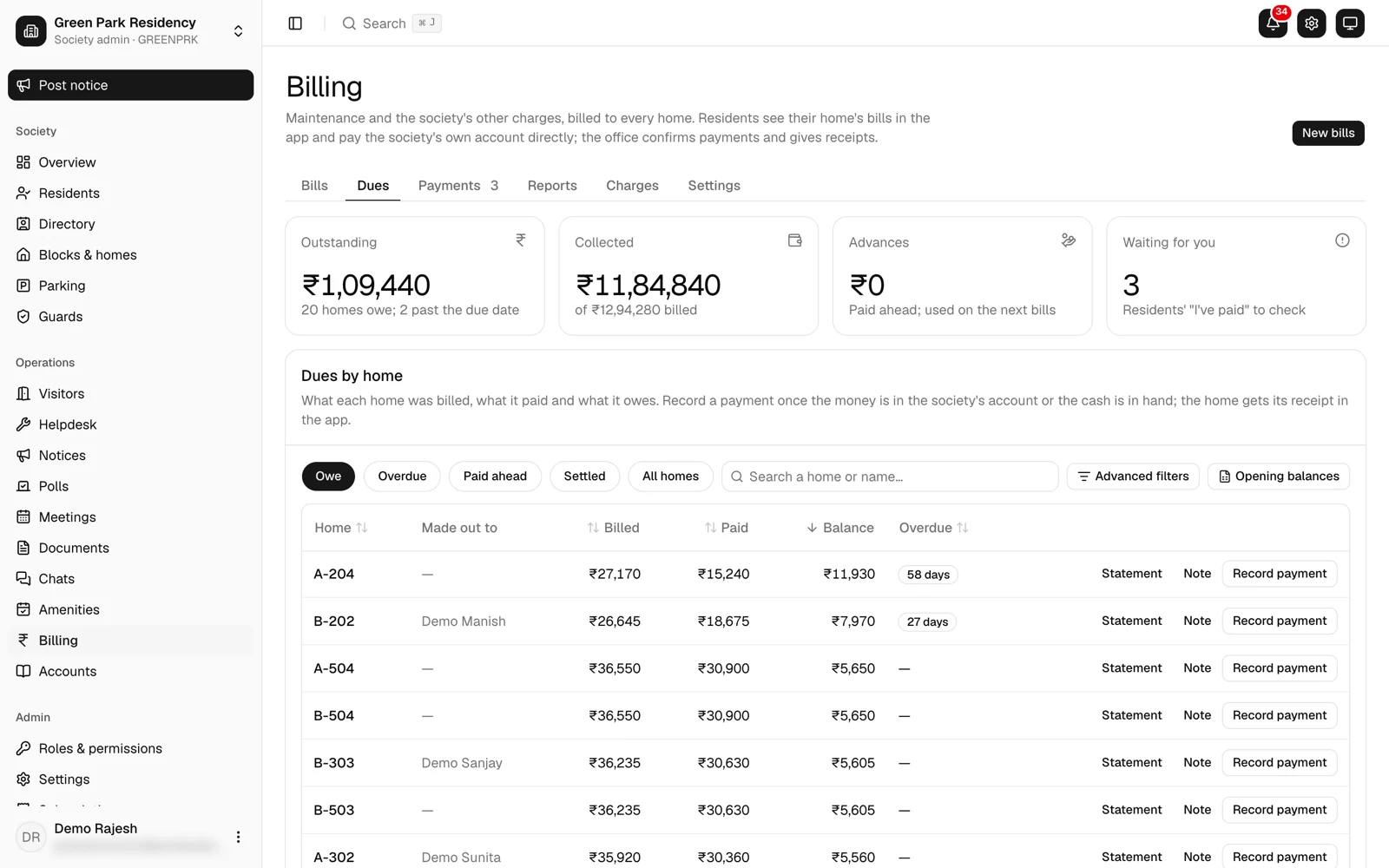
- The office sees dues by days overdue, each home’s statement, and the ageing, collection and defaulters reports, with Excel export. See dues and reports.
- The office can send a message only to homes with dues, in the society’s own words, and see who got it and who read it. See messages to chosen homes.
- A no-dues NOC comes as a PDF only once the home owes nothing. See material passes and the NOC.
Questions committees ask
Can the society charge interest on unpaid maintenance?
Usually yes, if your bye-laws allow it. The rate and the way it is worked out are set by the bye-laws or the general body. Show interest separately from the principal on every bill and notice.
Can a defaulter vote or stand for the committee?
In many societies a member in default cannot stand for election or may lose some rights until the dues are paid. Your state’s co-operative societies act and your bye-laws set who counts as a defaulter for this, from what date, and which rights are affected. Read both before the notice of the meeting goes out, and see the AGM notice and minutes format for the meeting itself.
What if the home is sold while dues are unpaid?
The dues stay with the home. Most societies ask for the dues to be cleared before they issue a no-dues NOC for the sale. Our society NOC format has the letters and the checks before signing. In Ekvasa, recording a sale shows the home’s dues first and keeps them with the home.
Should we accept part payments?
Many committees do, to keep the home paying. Record each part payment against the oldest bill first and confirm the balance in writing.
Where to check the rules
These official sources are examples to read for yourself, not rules that apply to every society. Your state’s law and your society’s own bye-laws have the final word.
- Ministry of Co-operation, state co-operative societies acts
- Ministry of Co-operation, websites of state co-operation departments
- Digital Personal Data Protection Act, 2023 (MeitY)
- India Code (Legislative Department), official text of central acts such as the Societies Registration Act, 1860
- India Code: the central and state acts, from the Government of India
- Your state’s co-operative department and the registrar’s office for your area, and your society’s registered bye-laws.
Do this in Ekvasa
Ekvasa keeps bills, receipts, notices and records in one app for the office and every home. The Ekvasa team sets your society up with your own data.