
Guide
Sinking fund in a housing society: meaning and formula
Updated
Written by the Ekvasa team at Colligo Infotech. How we write our guides.
This guide is general information, not legal advice. The rules differ from state to state and with your society’s bye-laws, so check them, and ask a lawyer or your registrar when in doubt.
What is a sinking fund in a society? The meaning
Big jobs such as waterproofing or a new lift cost far more than one year’s maintenance. A sinking fund spreads that cost over many years: each home pays a small share on every bill, so the money is there when the job comes.
Sinking fund, repair fund and maintenance: what is the difference?
They look alike on the bill but pay for different things.
| Fund | What it pays for | When it is spent |
|---|---|---|
| Maintenance | Security, housekeeping, electricity, water, salaries | Every month |
| Repair fund | Repairs and upkeep that come up in a year | When the work is done |
| Sinking fund | Major repairs, rebuilding, replacing big parts | Years later, after general body approval |
Your bye-laws say what each fund is for; if they do not, the general body decides and records it in the minutes. A corpus fund is different again: usually paid once and kept as a reserve. See our corpus fund guide.
Some bye-laws add a major repairs fund. Maharashtra’s 2014 model bye-laws charge plastering, the compound wall and total painting to it, and keep the sinking fund for reconstruction, structural changes and heavy repairs certified by the architect. Check which fund your bye-laws charge each job to.
Sinking fund charges: how much should each home pay?
There is no single figure for all of India. Each state’s co-operative societies act and model bye-laws set their own rule, and an RWA follows its own. The share is usually set in one of three ways:
- A part of each home’s construction cost, collected each year.
- An amount based on each home’s carpet area.
- The same amount for every home.
Check your registered bye-laws first, then your state’s act (linked at the end of this page).
Sinking fund formula: how to calculate each home’s share
Use the method your bye-laws name. If they name none, the general body chooses one and records it in the minutes.
Method 1: a share of the construction cost
Maharashtra’s 2014 model bye-laws set the sinking fund at the rate the general body decides, "subject to the minimum of 0.25 per cent per annum of the construction cost". That is each home’s building cost certified by the architect, without the land. The general body can set a higher rate, not a lower one.
Yearly share = [certified construction cost of the home] × [rate in per cent] ÷ 100
Share on each monthly bill = yearly share ÷ 12
For example, with round figures not taken from any real society: a certified construction cost of 12,00,000 at the minimum 0.25 per cent gives 12,00,000 × 0.25 ÷ 100 = 3,000 a year, or 250 on each monthly bill. At 0.5 per cent it is 6,000 a year.
The cost is from when the building was built, so the share does not grow with repair costs unless the general body raises the rate.
Method 2: plan from the repairs ahead
This gives a figure the general body can check:
- List the big jobs due in the next 10 to 20 years, such as waterproofing, painting, lifts and pumps.
- Get a rough estimate for each from a contractor or engineer.
- Divide each estimate by the years until it is due, add the yearly amounts, and take off what the fund already holds.
- Share the total between the homes as your bye-laws say.
- Put it to the general body with the working and record the decision. Our AGM notice and minutes format has a resolution you can adapt.
For example, with round figures not taken from any real society or contractor:
| Job | Estimate | Years until due | To set aside each year |
|---|---|---|---|
| Terrace waterproofing | 6,00,000 | 6 | 1,00,000 |
| Outside painting and repair | 15,00,000 | 10 | 1,50,000 |
| Lift replacement | 20,00,000 | 20 | 1,00,000 |
| Total | 3,50,000 |
By carpet area: [yearly total] × [home's carpet area] ÷ [all homes' carpet area]
Equally: [yearly total] ÷ [number of homes]
In the example, a home of 800 square feet out of 40,000 pays 3,50,000 × 800 ÷ 40,000 = 7,000 a year, about 583 a month. Where bye-laws set a minimum, the plan can go above it but not below. The share goes on every bill as its own charge head.
Review the figure every few years, because repair costs rise.
Where should the society keep the money?
Keep it apart from daily spending:
- Show it as its own fund in the books.
- Keep the money in a separate bank account or fixed deposits, as your bye-laws allow.
- Add deposit interest to the fund, unless the general body decides otherwise.
- Show its balance in the yearly balance sheet.
- Keep a register of every addition and use, next to the maintenance register.
How should the society spend it?
- The committee writes down the work needed and why.
- It collects quotations, usually from more than one contractor.
- It puts the proposal, with the quotations, to the general body.
- The general body passes a resolution naming the work and the most it allows from the fund.
- The committee pays against bills and keeps every bill and receipt.
- The auditor checks the spending at the year-end audit.
Never pay daily costs such as salaries or electricity from the fund. Maharashtra’s 2014 model bye-laws, for example, allow it only for reconstruction, structural changes and heavy repairs certified by the architect, on the general body’s approval.
A resolution format you can copy
[Society name]
[Registration number]

Resolution passed at the [annual / special] general body meeting held on [date] at [place].

Resolved that the society carry out [the work, for example terrace waterproofing of Wing [wing]] as proposed by the managing committee.

Resolved further that a sum not more than [amount] be used from the society's sinking fund for this work, against the quotation of [contractor name] dated [date].

Resolved further that the managing committee is authorised to sign the work order, pay against bills and report the final cost to the next general body meeting.

Proposed by: [Name], [Home number]
Seconded by: [Name], [Home number]
Members present: [number]    For: [number]    Against: [number]

Secretary: [Name]          Chairman: [Name]
A sinking fund register
One page with every addition and use and a running balance. The auditor will ask for it.
Date | Details | Reference | Added | Used | Balance
[date] | Opening balance | [last year's audited figure] | | | [amount]
[date] | Collected with bills for [month] | Bill run [number] | [amount] | | [amount]
[date] | Interest on FD [FD number] | Bank [name] | [amount] | | [amount]
[date] | Terrace waterproofing | GBM resolution [number], bill [number] | | [amount] | [amount]
How Ekvasa helps
In Ekvasa, the sinking fund is a charge head on the bill, set for each home by carpet area or home type, and every bill run shows a preview first; see maintenance bills.
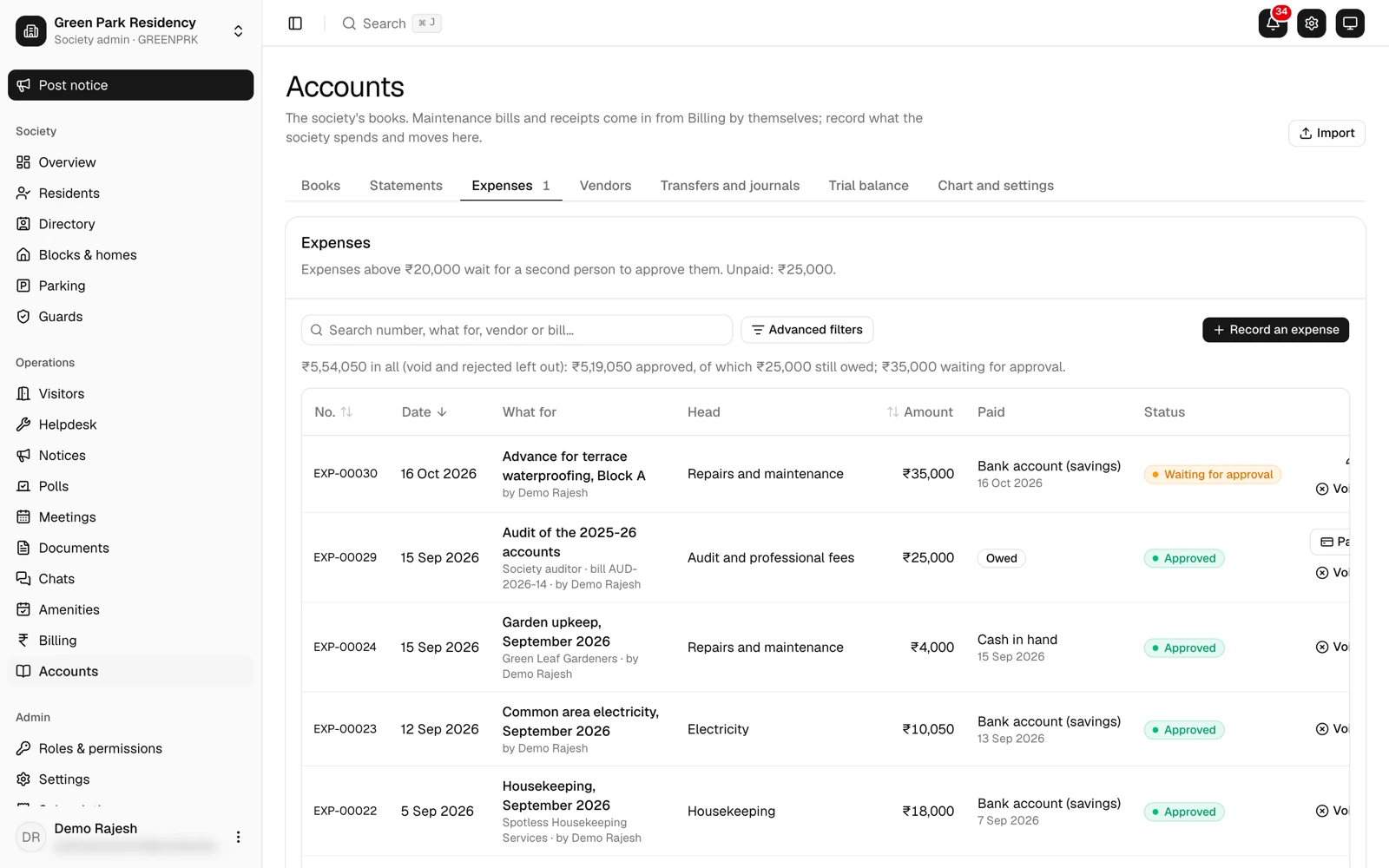
The double-entry books start with a chart of accounts that includes the sinking and repair funds, and bills and receipts post themselves, so the fund’s balance is always in the books. Fixed deposits are listed with a reminder before each matures, and the AGM and audit statements show the funds in the balance sheet.
Questions committees ask
Does a seller get the sinking fund back when they sell their home?
Usually not. The money was collected for the building and stays with the society. Check your bye-laws; if they are silent, the general body can record the rule in the minutes. The society NOC for the sale confirms the seller’s share is paid.
Can the society invest the sinking fund?
Bank fixed deposits suit it, because the money must be safe and ready when needed. Your state’s law and bye-laws say where a society may invest.
DICGC deposit insurance covers deposits in commercial and co-operative banks up to a limit for each depositor in each bank, but not in a primary co-operative society. Spreading large deposits across banks keeps more within the cover.
Source: dicgc.org.in, checked on 20 November 2026.
Is there GST on the sinking fund?
CBIC Circular 109/28/2019-GST, on charges collected by a residents’ welfare association, does not name the sinking fund. It sets two tests for members’ contributions:
- The monthly limit for each member. Members’ contributions for common use are exempt up to a monthly limit for each member, applied to each home separately.
- The society’s yearly turnover. A society within the GST registration threshold need not register or pay GST, even if some charges go over the monthly limit.
So if the share is on the same bill as maintenance, the careful course is to count it in each home’s monthly total and treat every home alike. Our guide to GST and TDS on society maintenance gives the limits and a court ruling on how GST applies above the limit. Ask your auditor for your own case.
Source: cbic-gst.gov.in, checked on 20 November 2026.
Terms such as charge head and GSTIN are explained in the housing society glossary.
Where to check the rules
These official sources are examples to read for yourself, not rules that apply to every society. Your state’s law and your society’s own bye-laws have the final word.
- Ministry of Co-operation, state co-operative societies acts
- Commissioner for Co-operation, Maharashtra, model bye-laws of a co-operative housing society (2014)
- CBIC Circular 109/28/2019-GST on charges collected by a residents' welfare association
- DICGC, deposit insurance questions
- India Code (Legislative Department), official text of central acts such as the Societies Registration Act, 1860
- India Code: the central and state acts, from the Government of India
- Your state’s co-operative department and the registrar’s office for your area, and your society’s registered bye-laws.
Do this in Ekvasa
Ekvasa keeps bills, receipts, notices and records in one app for the office and every home. The Ekvasa team sets your society up with your own data.