
Guide
Housing society bye-laws explained
Updated
Written by the Ekvasa team at Colligo Infotech. How we write our guides.
This guide is general information, not legal advice. The rules differ from state to state and with your society’s bye-laws, so check them, and ask a lawyer or your registrar when in doubt.
What are bye-laws in a housing society?
A co-operative housing society is registered under its state’s co-operative societies act. That act and the state’s rules apply to every society in the state. The bye-laws are the society’s own rules, registered with the Registrar of Co-operative Societies, that say how this society runs: who can be a member, how dues are fixed, how meetings are called and how the committee is chosen.
Bye-laws bind the society and every member, so the committee should read them before any big decision.
If your society is registered under another law, such as the Societies Registration Act, 1860, as many residents’ welfare associations are, its memorandum and registered rules do the same job. See what an RWA is for the difference.
What do bye-laws cover?
Each state’s model is laid out differently, but most cover the same ground:
| Part | What it decides |
|---|---|
| Name, address, area | The society’s registered name and address, and how to change them |
| Objects | What the society exists to do, such as managing the building and common areas |
| Funds | Share capital, the reserve fund, the repair and sinking fund, and how they are invested |
| Members | Who can join, rights, transfer of a home, nomination, leaving and expulsion |
| Charges | The charge heads on the bill and how each home’s share is worked out |
| General meetings | The AGM and special meetings, notice, quorum and voting |
| Managing committee | Its size, election, term, powers and meetings |
| Accounts and audit | Books, registers, the yearly audit and writing off dues |
| Disputes and complaints | How a member’s complaint is heard |
The act, the rules and the bye-laws: which comes first?
The order is always the same:
- The state’s act passed by the state legislature.
- The state’s rules made under that act.
- Your society’s registered bye-laws.
A bye-law cannot go against the act or the rules. Gujarat’s model bye-laws for a housing co-operative society say so directly: where a bye-law conflicts with the act or rules, the act and rules prevail. General body resolutions and house rules, such as the timing for the gym or parking, come below the bye-laws and must fit within them.
How does a new society adopt bye-laws?
Promoters of a new society usually start from the state’s model bye-laws for housing societies, fill in the blanks such as the name, address and area of operation, and file them with the registration papers. The Registrar registers the bye-laws with the society.
Delhi’s rules, for example, say the Registrar makes model bye-laws for each class of society, which the promoters may adopt with or without changes. Changes must still fit the act and the rules.
Source: rcs.delhi.gov.in.
How to amend bye-laws, step by step
Your state’s act and rules set the majority and papers, but the steps are much the same:
- The committee drafts the change. Write the present bye-law, the new wording and the reason, side by side.
- Give notice to every member. Send the proposal with the general body meeting notice, as early as your bye-laws require. Our AGM notice format shows how to word an agenda item.
- Pass a resolution at the general body meeting. Many states ask for a special majority, often two-thirds of the members present. Record the count in the minutes.
- Apply to the Registrar within the time your state’s rules set, with the resolution, the old and new wording and the other papers they list.
- Wait for registration. The change takes effect only once it is registered; keep the certified copy the Registrar gives. Until then, the old bye-law still applies.
- Update every copy and keep the certified copy with the registration papers.
A resolution format you can copy
[Society name]
[Registration number]

Resolution passed at the [annual / special] general body meeting held on [date] at [place], notice of which, with the proposed amendment, was sent to all members on [date].

Resolved that bye-law No. [number] of the society's registered bye-laws be amended to read as follows:
"[new wording]"

Resolved further that the managing committee is authorised to apply to the Registrar of Co-operative Societies for registration of this amendment and to sign the papers needed.

Proposed by: [Name], [Home number]
Seconded by: [Name], [Home number]
Members present: [number]    For: [number]    Against: [number]

Secretary: [Name]          Chairman: [Name]
State examples
These are examples, not a rule for all of India. Check your own state’s act, rules and model bye-laws; the Ministry of Co-operation keeps a list of state acts. Every official page named below is linked at the end of this page.
Maharashtra
The Commissioner for Co-operation’s model bye-laws page lists the 2014 model bye-laws for co-operative housing societies in English, a Marathi version and other housing types. In 2026 the page also listed a draft of revised model bye-laws for tenant co-partnership housing societies, put up for suggestions and objections, so check the page for the latest status.
Bye-law 165 of the 2014 model sets three conditions to make, change or remove a bye-law:
- the proposal is sent to all members 14 days before the general body meeting;
- the resolution is passed by at least two-thirds of the members present and voting;
- the change is approved and registered by the Registering Authority.
Bye-law 23 lets a member get a copy of the approved bye-laws on paying the charges the bye-laws set.
Gujarat
The Registrar of Co-operative Societies, Gujarat, publishes model bye-laws for a housing co-operative society and a housing service co-operative society, in Gujarati. Its acts and rules page has the Gujarat Co-operative Societies Act, 1961, its amendment acts and the Gujarat Co-operative Societies Rules, 1965.
Under section 13 of the act:
- an amendment is not valid until the Registrar registers it;
- the society sends the Registrar a copy of the amendment passed at a general meeting in the manner the rules prescribe;
- if it is not against the act or rules, the Registrar may register it; the Registrar must hear the society before refusing, and must decide within sixty days;
- the Registrar’s certified copy is conclusive proof of registration.
Section 14 lets the Registrar ask a society to make an amendment in its own interest, except for its name or objects. The model bye-laws give the general meeting the power to amend bye-laws and ask for at least 15 days’ notice of a general meeting, which may also go by email or WhatsApp.
Delhi
The Registrar of Co-operative Societies, Delhi, lists model bye-laws, including those for co-operative group housing societies. Rule 12 of the Delhi Co-operative Societies Rules, 2007 says:
- the amendment is passed at a general body meeting by at least two-thirds of the members present, after due notice;
- a copy goes to the Registrar within thirty days, with the old and new bye-laws, the reasons, four signed copies of the amended bye-laws and proof of the notice;
- the Registrar decides within ninety days; if there is no decision by then, the amendment is treated as registered.
Other states
Every state has its own act, rules and Registrar. Open the Ministry of Co-operation’s list of state acts, then your state’s co-operation department site for its model bye-laws.
How Ekvasa helps
In Ekvasa, the society’s documents shelf keeps the bye-laws, minutes, audit reports and circulars where members can open them, so everyone reads the same current copy.
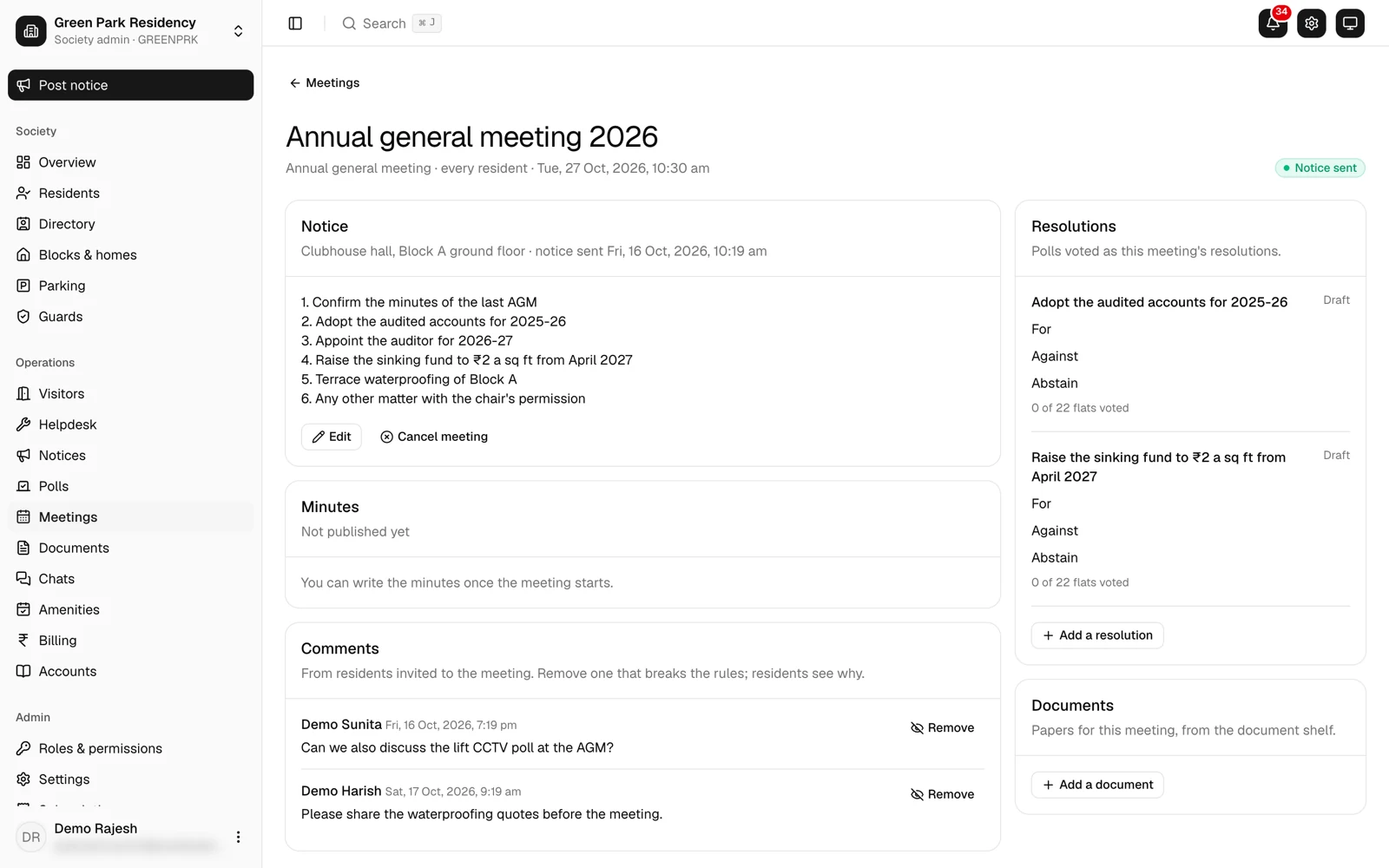
Meetings carry the notice and agenda, polls as resolutions and the minutes, so the proposal and the count are on record. A poll counts one vote per home; the majority your state’s law asks for still applies.
Questions committees ask
Can the committee change a bye-law on its own?
No. Only the general body can amend bye-laws, and the change counts only once the Registrar registers it.
Can our bye-laws differ from the model bye-laws?
Yes, as long as they fit your state’s act and rules. The model is a starting point; your registered bye-laws are what apply to your society.
How do I get a copy of my society’s bye-laws?
Ask the society office. Members usually have a right to a copy; Maharashtra’s 2014 model, for example, gives one on paying the copy charges. The Registrar’s office keeps the registered copy too.
What if a bye-law and the act disagree?
The act and rules prevail. Ask the committee to propose an amendment so the bye-laws match.
Terms such as general body and quorum are explained in the housing society glossary.
Where to check the rules
These official sources are examples to read for yourself, not rules that apply to every society. Your state’s law and your society’s own bye-laws have the final word.
- Ministry of Co-operation, state co-operative societies acts
- Commissioner for Co-operation, Maharashtra, model bye-laws page
- Commissioner for Co-operation, Maharashtra, model bye-laws of a co-operative housing society (2014)
- Registrar of Co-operative Societies, Gujarat, model bye-laws
- Registrar of Co-operative Societies, Gujarat, acts and rules
- Registrar of Co-operative Societies, Delhi, model bye-laws of co-operative societies
- Registrar of Co-operative Societies, Delhi, the Delhi Co-operative Societies Rules, 2007
- India Code (Legislative Department), official text of central acts such as the Societies Registration Act, 1860
- India Code: the central and state acts, from the Government of India
- Your state’s co-operative department and the registrar’s office for your area, and your society’s registered bye-laws.
Do this in Ekvasa
Ekvasa keeps bills, receipts, notices and records in one app for the office and every home. The Ekvasa team sets your society up with your own data.