
Guide
Society maintenance bill and receipt format (free template)
Updated
Written by the Ekvasa team at Colligo Infotech. How we write our guides.
This guide is general information, not legal advice. The rules differ from state to state and with your society’s bye-laws, so check them, and ask a lawyer or your registrar when in doubt.
What should a society maintenance bill show?
A bill is the society’s written demand for one period. A member should be able to read it and know three things: what is charged and why, what is still unpaid from before, and how much to pay by when.
Keep every bill in the same layout, numbered in one unbroken series.
What a society may charge, and how each charge is shared between homes, is set by your state’s co-operative societies law, your registered bye-laws and the general body’s resolutions. Check them before you add a new head.
A maintenance bill format you can copy
Change the words in square brackets. Leave out a head your society does not charge.
[Society name]
Registration No. [registration number]
[Society address]
GSTIN: [GSTIN, only if the society is registered for GST]

MAINTENANCE BILL

Bill No.: [bill number]          Bill date: [date]
Home No.: [Home number], [Block or wing]
Member: [Member name]
Area: [carpet area, if charges go by area]
Period: [from date] to [to date]

Sr. | Charge head | Amount
1 | Maintenance (service charges) | [amount]
2 | Sinking fund | [amount]
3 | Repair and maintenance fund | [amount]
4 | Water charges | [amount]
5 | Parking charges | [amount]
6 | [Other head approved by the general body] | [amount]

Current charges for this period: [amount]
Add: Arrears up to [date] (bills [bill numbers]): [amount]
Add: Interest on arrears as per bye-law [bye-law number]: [amount]
Less: Advance or credit carried forward: [amount]
TOTAL PAYABLE: [amount]
Amount in words: [amount in words]

Due date: [due date]
Interest as per bye-law [bye-law number] applies to any amount unpaid after the due date.

How to pay:
UPI to the society's own account: [society UPI ID]
Bank transfer: [society bank name], A/c [society account number], IFSC [IFSC]
Cheque in favour of: [society name as on the bank account]
Please write the bill number in the payment note.

For [Society name]
[Signature]
[Name], Secretary / Treasurer
This is a bill, not a receipt. A receipt is issued when the payment reaches the society.
What each charge head means
| Head | What it pays for | Usually decided by |
|---|---|---|
| Maintenance (service charges) | Staff, security, cleaning, common electricity, lifts | General body, by area or by home |
| Sinking fund | Major repairs and replacements years later | State law and bye-laws |
| Repair and maintenance fund | Regular repairs to the building | General body |
| Water charges | The society’s water bills and tankers | Bye-laws, often by home or by meter |
| Parking charges | Allotted parking spaces | Committee, with the general body’s approval |
| Arrears | Earlier bills still unpaid | Carried from the home’s ledger |
| Interest on arrears | Late payment | Bye-laws or general body |
| Advance or credit | Money paid ahead, or a credit note | Carried from the home’s ledger |
Points to watch:
- Show arrears and interest on their own lines, never mixed into the current charges. A member who disputes old dues should still be able to see and pay this period’s bill.
- Name the bye-law that allows the interest. If your bye-laws do not allow interest, do not charge it.
- Some heads exist only in some states or societies, such as a non-occupancy charge for a home that is let out, or a share of property tax collected by the society. Add one only when your state’s law, your bye-laws and the general body allow it.
- Funds stay separate. Keep the sinking fund and repair fund as their own heads, so their totals are clear in the books. See the sinking fund guide.
A maintenance receipt format you can copy
Issue a receipt only when the money has reached the society: cash in hand, a cheque that has cleared, or a UPI or bank entry the office has found in the society’s account. A payment screenshot is not a receipt.
[Society name]
Registration No. [registration number]
[Society address]

RECEIPT

Receipt No.: [receipt number]          Date: [date]
Received from: [Member name]
Home No.: [Home number], [Block or wing]

The sum of: [amount]
Amount in words: [amount in words]

Towards: Bill No. [bill numbers] for the period [period]
Mode: [Cash / Cheque / UPI / Bank transfer]
Cheque No. or UTR: [reference]          Dated: [date]
Bank: [bank name, for a cheque]

Balance due after this payment: [amount]
Advance carried to the next bill: [amount]

For [Society name]
[Signature]
[Name], Treasurer / Authorised signatory
Cheque payments are subject to realisation.
Keeping a receipt book
If the office writes receipts by hand, use a printed receipt book with numbered pages and a carbon copy, and keep each book in one series. Never tear out a used page: if a receipt is wrong, write "Cancelled" across it, keep both copies, and issue a new one. Each receipt also goes into the receipt register, as shown in our maintenance register format.
Columns for a maintenance Excel sheet
In a spreadsheet, use one sheet for bills, one for receipts and one for each home’s ledger:
| Sheet | Columns |
|---|---|
| Bills | Bill no., date, home, member, period, one column for each head, arrears, interest, total, due date |
| Receipts | Receipt no., date, home, mode, UTR or cheque no., bills settled, amount |
| Home ledger | Date, details, bill or receipt no., billed, paid, balance |
Three habits keep a spreadsheet honest:
- Work out the totals with formulas, not by typing them, and check that the bills sheet total matches the total billed.
- Never overwrite a past row. Correct a mistake with a new credit note or debit note row.
- Keep a dated copy each month outside the office computer.
Does a society maintenance bill need GST?
Only in some cases. The CBIC’s Circular 109/28/2019-GST sets two tests for a residents’ welfare association, a body of residents that collects charges from its members for their common use:
- A monthly limit for each member. Members’ contributions for common use are exempt from GST up to a set amount a month for each member. If a member’s charges go over it, GST applies to the whole amount, not only the part above it.
- A yearly turnover threshold. A society whose yearly turnover stays within the threshold need not register or pay GST, even if some charges go over the monthly limit.
Source: cbic-gst.gov.in, checked on 20 November 2026.
The circular, linked below, gives the exact limits. A society registered for GST adds its GSTIN to the bill.
Where a home’s charges are taxable, the bill must work as a tax invoice: section 31(2) of the CGST Act says a tax invoice for services shows the description, the value, the tax charged and the other particulars the rules prescribe. For exempt charges, section 31(3)(c) calls for a bill of supply instead.
Source: cbic-gst.gov.in, checked on 20 November 2026.
Our sinking fund guide explains how the two tests apply to each home. Ask the society’s auditor or a tax adviser for your own case.
How Ekvasa makes the bill and the receipt
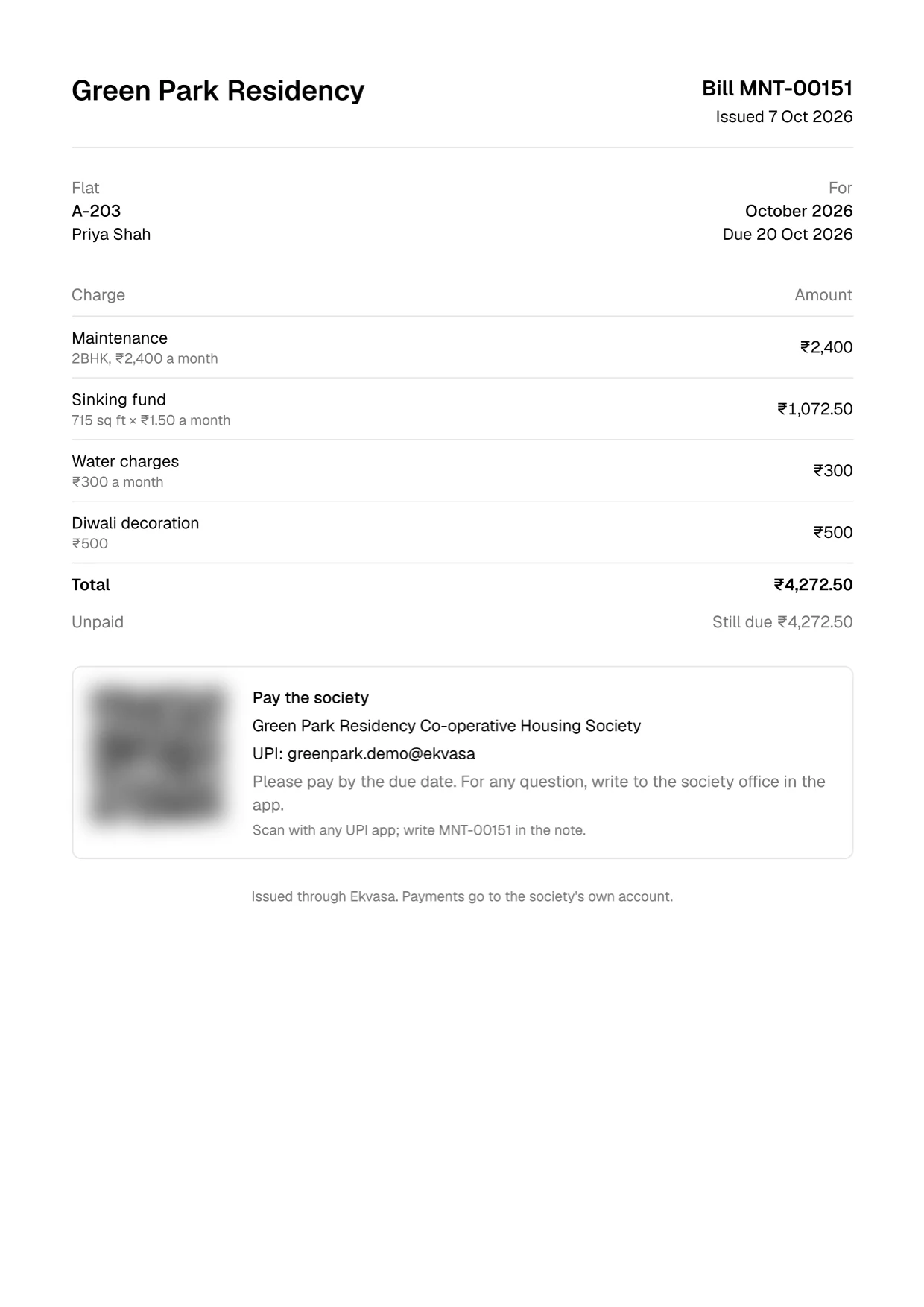
In Ekvasa each charge, such as maintenance, the sinking fund or water, is a charge head set for each home by carpet area or by home type.
The office runs bills monthly, quarterly or yearly, sees a preview first, and every bill is numbered in the society’s own series. A bill is never edited once it has gone out: a credit note or a debit note corrects it. See maintenance bills.
The society adds its logo, address, registration number, signature and terms once, and every copy of the bill looks the same on phones, on paper and as a PDF. Every bill carries a UPI link and QR with the society’s own UPI ID, so the money goes straight to the society’s bank account.
After paying, the resident taps I’ve paid and adds the amount, the date and the UTR. The office checks it against the bank and confirms it, and the resident gets a receipt in the app, as a PDF in English, Gujarati or Hindi. At the end of the financial year, one receipt lists every payment with the total. See payments and receipts.
Questions committees ask
Can the society send bills and receipts by WhatsApp or email?
Many do. Check that your bye-laws do not name a different way to serve bills, and keep a copy of every bill and receipt the office sends. For reminder words, see our maintenance reminder format.
Who should sign the bill and the receipt?
Usually the secretary or treasurer, or another office-bearer the committee authorises. Your bye-laws may name who signs. Use the same signatory on every receipt in a book.
What if a member pays less than the bill?
Record the part payment and give a receipt for what was received. Settle the oldest bill first and show the balance on the receipt. If a home keeps falling behind, follow our steps for maintenance defaulters.
Where to check the rules
These official sources are examples to read for yourself, not rules that apply to every society. Your state’s law and your society’s own bye-laws have the final word.
- CBIC Circular 109/28/2019-GST on charges collected by a residents' welfare association
- Central Goods and Services Tax Act, 2017 (CBIC), section 31 on tax invoices
- India Code (Legislative Department), official text of central acts
- India Code: the central and state acts, from the Government of India
- Your state’s co-operative department and the registrar’s office for your area, and your society’s registered bye-laws.
Do this in Ekvasa
Ekvasa keeps bills, receipts, notices and records in one app for the office and every home. The Ekvasa team sets your society up with your own data.