
Guide
Society maintenance charges rules in India
Updated
Written by the Ekvasa team at Colligo Infotech. How we write our guides.
This guide is general information, not legal advice. The rules differ from state to state and with your society’s bye-laws, so check them, and ask a lawyer or your registrar when in doubt.
Who decides the maintenance charges?
Three things decide what a home pays, in this order:
- Your state’s law. A co-operative housing society works under its state’s co-operative societies act and rules. An apartment owners’ association or an RWA works under the act it is registered under and its own registered rules.
- Your registered bye-laws. They list the charge heads, how each is shared and the interest on late payment. Many states publish model bye-laws, but only the version your society adopted and registered binds it.
- The general body. Within the bye-laws, the general body fixes rates such as the repair fund contribution and the interest on late payment. The committee then works out each home’s share and sends the bills.
Before the society takes over, the builder usually runs the building. The Real Estate (Regulation and Development) Act, 2016 makes the promoter responsible for essential services, on reasonable charges, until the association of allottees takes over maintenance. Each buyer must pay their share of maintenance charges, municipal taxes, water and electricity charges as the agreement for sale sets out, with interest for delay at the rate the rules prescribe.
Source: indiacode.nic.in, checked on 20 November 2026.
Which charges can a society collect?
A society can collect only the charges its registered bye-laws allow, at the rates the general body fixes. These are the usual heads on a maintenance bill:
- Monthly maintenance. Staff salaries, security, cleaning, common lights, office and audit costs, as decided by the general body under the bye-laws.
- Repair fund and major repairs. A regular amount for repairs, and a one-time amount for a big job such as painting or waterproofing, as decided by the general body under the bye-laws.
- Sinking fund. Savings for major structural repair or rebuilding, as decided by the general body under the bye-laws.
- Parking. A charge for an allotted parking slot, as decided by the general body under the bye-laws.
- Water. The society’s water bill, shared by connection, meter or equally, as decided by the general body under the bye-laws.
- Non-occupancy charges. An extra amount from a member who has let out the home, only where the state’s rules allow it, as decided by the general body under the bye-laws. Maharashtra caps it at 10% of the service charges, as shown below. Our non-occupancy charges guide has more.
- Common areas. Upkeep of lifts, gardens, the clubhouse and other shared spaces, as decided by the general body under the bye-laws.
A charge the bye-laws do not name, or a rate the general body never approved, can be questioned.
Per square foot or equal for every home?
A charge can be shared by area, such as a rate per square foot, or as an equal amount for every home. Most bye-laws use both, picking the way that fits each head. A common pattern looks like this:
| Charge head | Usually shared | Why |
|---|---|---|
| Staff salaries, office, audit | Equally by every home | Every home gets the same service |
| Lift running and repair | Equally in that building | All homes there pay, used or not |
| Repair fund, sinking fund | By construction cost or area | Bigger homes cost more to repair |
| Building insurance | By built-up area | The premium follows the area |
| Property tax | As the local body bills it | Each home has its own tax |
| Water | By connections or a meter | Use differs by home |
Your bye-laws may split heads differently. Billing a head by area when they say equally, or the other way round, invites a dispute. Change a method only by amending the bye-laws as your state’s law sets.
For the sinking fund in detail, see our sinking fund guide.
Can a society charge interest on late payment?
Yes, if the bye-laws allow it, at the rate they or the general body set. A few points keep it fair:
- Charge interest only from the due date in the bye-laws, and only at the rate they allow.
- Show the interest apart from the principal on every bill and notice.
- Apply it the same way to every home. Waiving it for some homes and not others is a common cause of disputes.
For the steps when a home still does not pay, see maintenance defaulters: what to do.
What have courts said about maintenance charges?
Court rulings depend on the facts and on the state law in each case, so read the judgment itself before relying on it. Two rulings are often quoted:
- Bombay High Court, Mont Blanc Co-operative Housing Society v. State of Maharashtra, 2 March 2007. The court upheld the Maharashtra government’s 2001 order under section 79A of the Maharashtra Co-operative Societies Act, 1960, which says non-occupancy charges should not be more than 10% of the service charges. It said that a society cannot use its bye-laws as a way of making money from members who let out their homes. It also held that the exemption for homes lived in by family covers members of the family, including a married daughter and grandchildren.
Source: indiankanoon.org, checked on 20 November 2026.
- Supreme Court of India, Income Tax Officer, Mumbai v. Venkatesh Premises Co-operative Society Ltd., 12 March 2018, Civil Appeal No. 2706 of 2018. This is a tax case. The court held that non-occupancy charges and similar receipts a co-operative society collects from its members for their common benefit fall under the principle of mutuality, so they are not taxable income of the society.
Source: indiankanoon.org, checked on 20 November 2026.
Many websites quote a "Supreme Court judgement on society maintenance charges" without a case name, court or date. If someone relies on a ruling, ask for those three details and read the judgment on the court’s own website.
Maharashtra rules, and where to find your state’s
The 2014 model bye-laws for co-operative housing societies, on the Maharashtra Co-operation Commissioner’s website, show what state rules look like. They say, among other things:
- Service charges, such as staff salaries, office costs and audit fees, are divided equally by the number of units.
- Lift repair and running costs are shared equally by all members of that building, whether they use the lift or not.
- Insurance, lease rent and non-agricultural tax are shared by built-up area. Water charges follow the number and size of inlets in each home, and property tax is as the local authority fixes it.
- The repair and maintenance fund is at least 0.75% a year, and the sinking fund at least 0.25% a year, of each unit’s construction cost, at the rate the general body fixes.
- A member pays simple interest of up to 21% a year on overdue charges, or a lower rate fixed by the general body.
Source: sahakarayukta.maharashtra.gov.in, checked on 20 November 2026.
Model bye-laws are revised from time to time, so check the version your society registered. Every other state has its own act, rules and often model bye-laws; the Ministry of Co-operation lists them, linked at the end of this page.
How Ekvasa helps the office
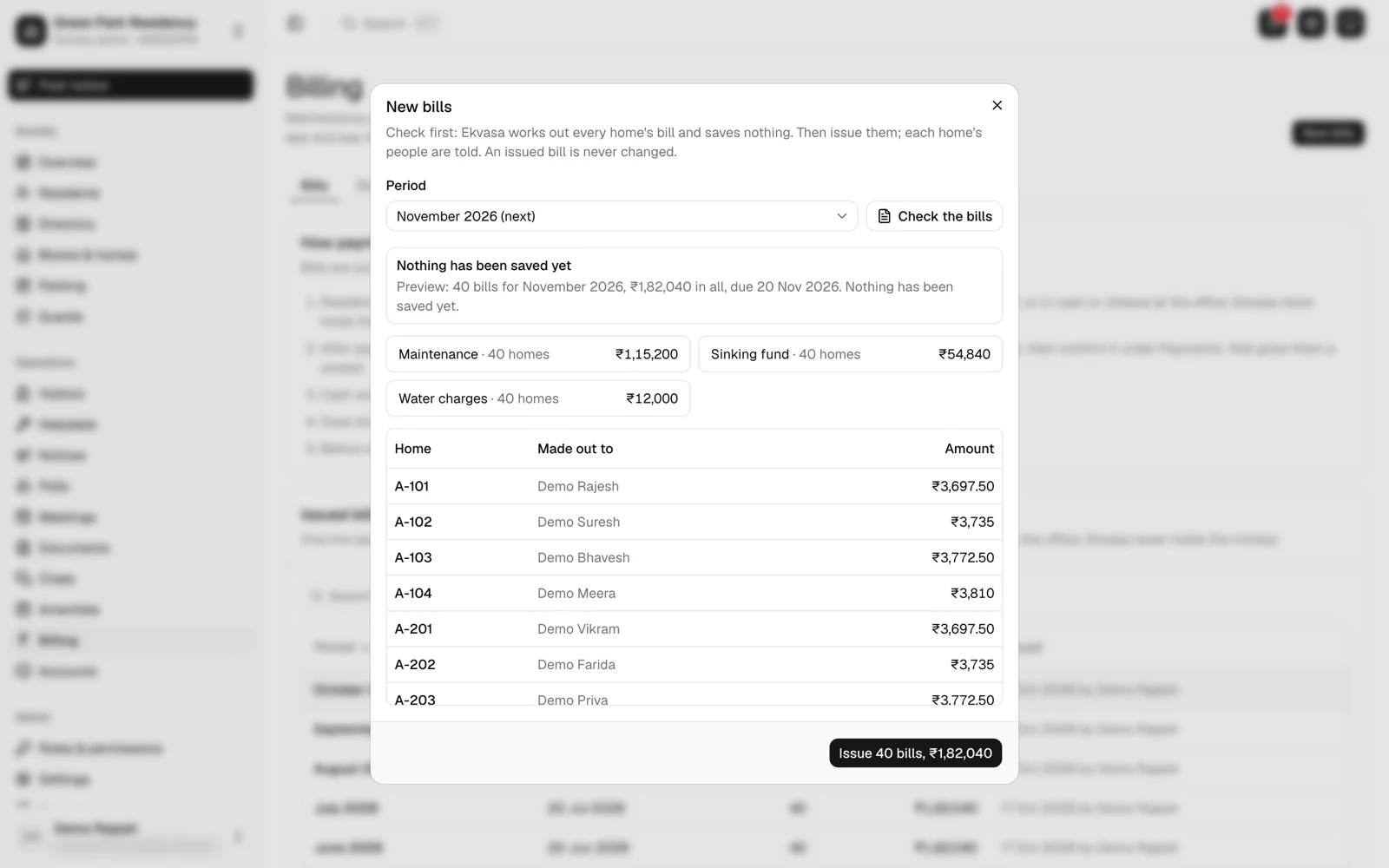
In Ekvasa each charge the society bills, such as maintenance, the sinking fund, the repair fund, water or parking, is a charge head. The office sets each head for every home by carpet area or by home type, to match the bye-laws, and sees a preview before the bills go out. See how bills are made.
A late fee stays off unless the society turns it on. It can be a fixed amount or simple interest on what is overdue, after the grace days the society chooses, so it follows the rate your general body fixed. See reminders and late fees.
Questions members ask
Can the society charge a bigger home more?
For heads the bye-laws share by area, yes. For heads they share equally, such as service charges in many bye-laws, every home pays the same. Read the bye-law for each head.
Do I have to pay for the lift or the gym if I do not use them?
Usually yes, if the bye-laws share that cost among all homes, whether each one uses it or not. The Maharashtra lift rule above is one example.
Who do I complain to about wrong charges?
First write to the committee and ask for the bye-law and the resolution behind the charge. If it is not settled, a member of a co-operative society can usually approach the registrar’s office for the area. Your state co-operation department’s website lists the offices.
Where to check the rules
These official sources are examples to read for yourself, not rules that apply to every society. Your state’s law and your society’s own bye-laws have the final word.
- Ministry of Co-operation, state co-operative societies acts
- Ministry of Co-operation, websites of state co-operation departments
- Real Estate (Regulation and Development) Act, 2016 (India Code)
- India Code (Legislative Department), official text of central acts
- Your state’s co-operative department and the registrar’s office for your area, and your society’s registered bye-laws.
Do this in Ekvasa
Ekvasa keeps bills, receipts, notices and records in one app for the office and every home. The Ekvasa team sets your society up with your own data.